

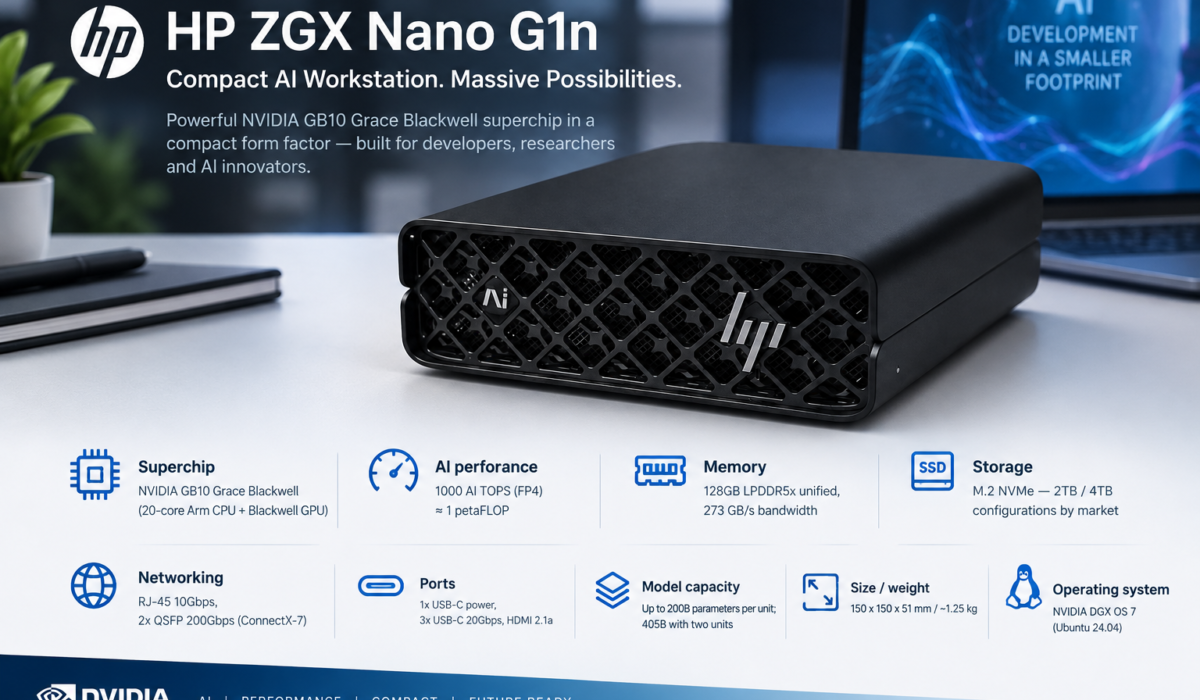
HP ZGX Nano G1n: The Z Workstation Brand Enters the AI Mini Server Arena
In our series on NVIDIA GB10 “AI mini servers,” Prology has covered nearly the full roster: the first-party DGX Spark, the ASUS GX10, the MSI MS-C931, the GIGABYTE AI TOP ATOM, and the Acer Veriton GN100. One notable name hasn’t had its own introduction yet: the HP ZGX Nano G1n — the machine that brings HP’s Z workstation brand into this segment, with the clearest large-enterprise positioning of the group. This article covers the ZGX Nano in full: design, specs, what HP adds to a family of near-identical hardware, and where it lands against its GB10 siblings.
What is the HP ZGX Nano G1n?
The ZGX Nano G1n is HP’s answer to the personal AI supercomputer wave NVIDIA started with the DGX Spark platform. The name tells you the positioning: “Z” is HP’s long-standing professional workstation brand — a familiar face in design studios, engineering departments, and large enterprises; “GX” marks it as part of HP’s new ZGX AI family (which also includes the higher-end Fury systems); and “Nano” describes it accurately — a 150 x 150 x 51 mm block at roughly 1.25 kg, the GB10 family’s shared form factor.
Like every family member, the ZGX Nano’s heart is the NVIDIA GB10 Grace Blackwell Superchip: a 20-core Arm CPU (10 Cortex-X925 + 10 Cortex-A725) fused with a Blackwell-architecture GPU on one die, sharing 128GB of unified memory at 273 GB/s, rated at 1000 AI TOPS (FP4) — running models of up to 200 billion parameters on one unit, or up to 405 billion with two units joined over the ConnectX-7 ports. It runs NVIDIA DGX OS 7 on Ubuntu 24.04 with the AI stack preinstalled.
In other words: on raw capability, the ZGX Nano is neither more nor less than any other GB10 machine — and as we’ve stressed throughout this series, that’s exactly what makes the remaining differences worth reading about.
Design: a diamond lattice like no one else’s
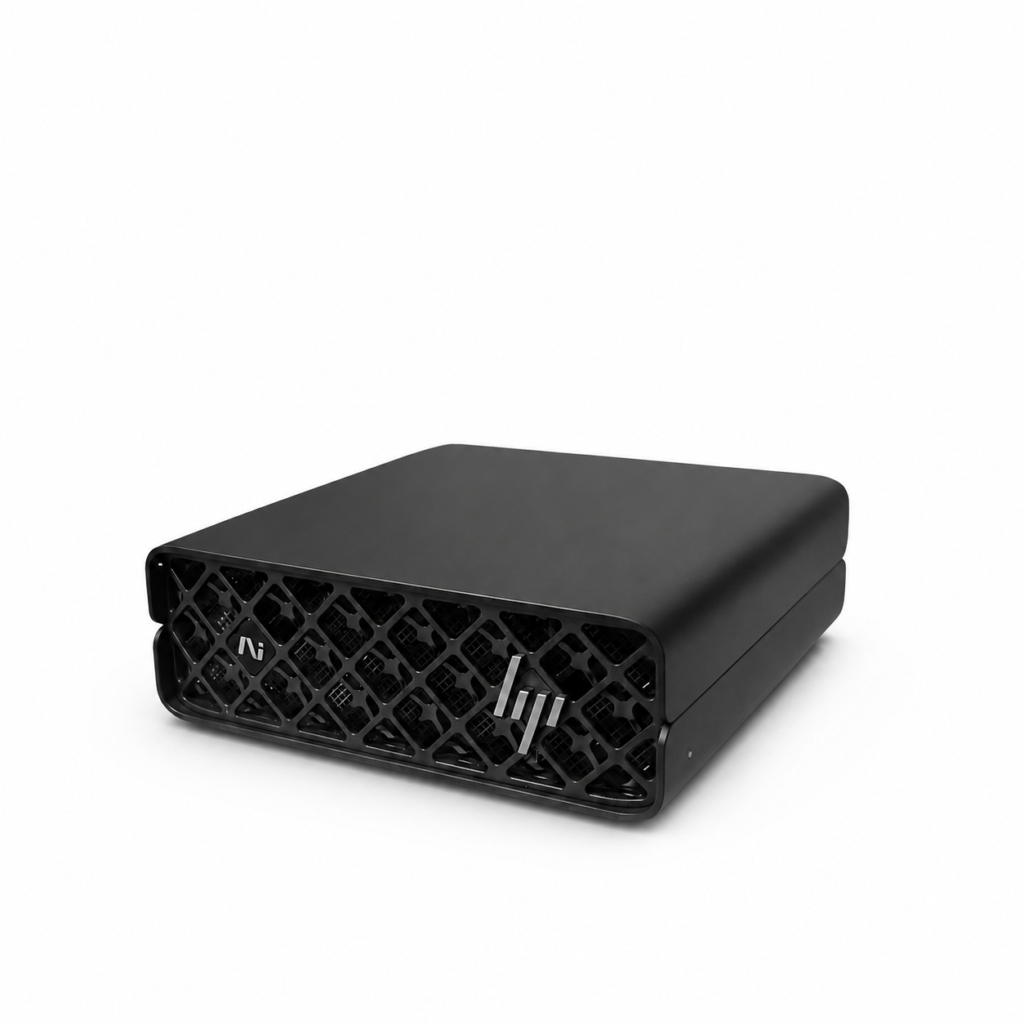
Across a GB10 lineup where every vendor picks its own grille treatment — MSI’s honeycomb, Acer’s vertical slats, GIGABYTE’s wave pattern — HP chose a diamond lattice covering both the front and the rear face, with the HP logo and a small “AI” badge in the corner. It’s the only machine in the family wearing a patterned grille on both ends, making the ZGX Nano recognizable even from behind — a small detail that shows HP invested in its own design language rather than reusing the reference shell.
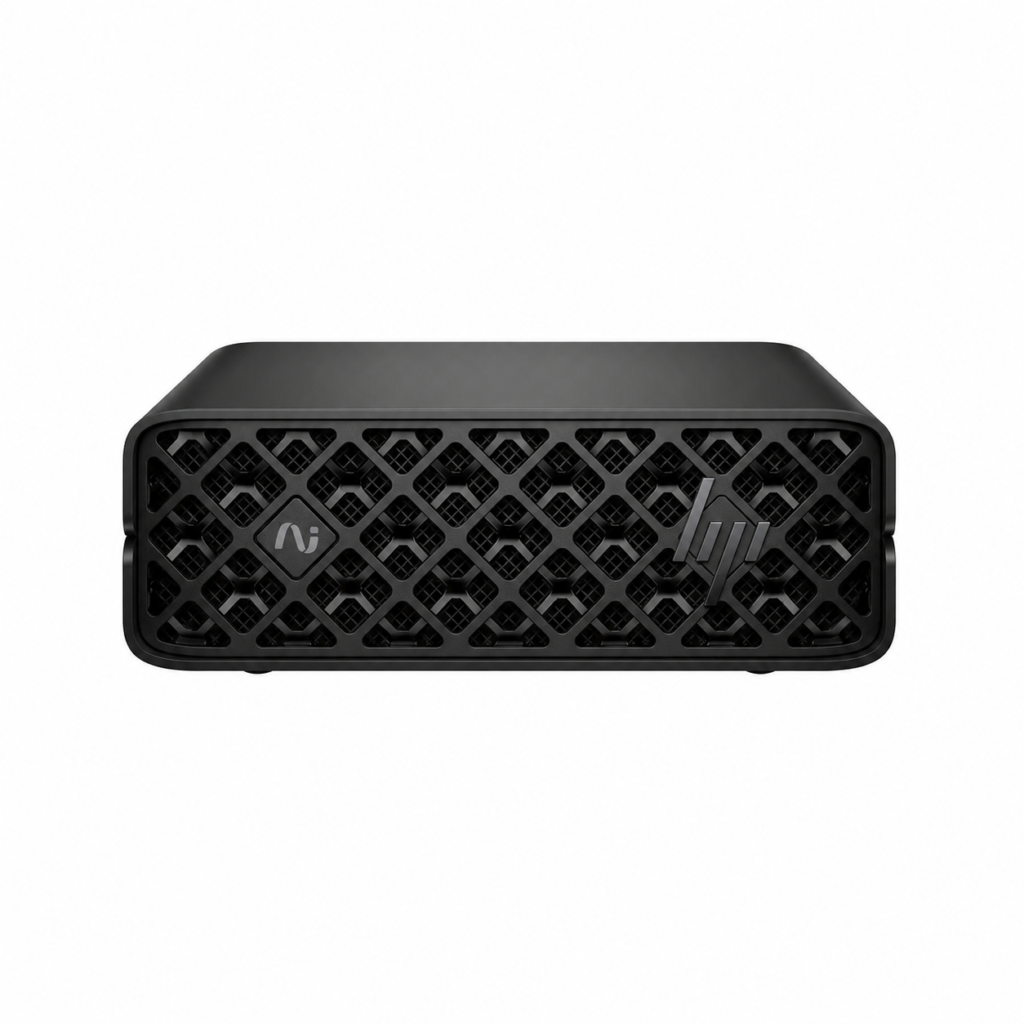
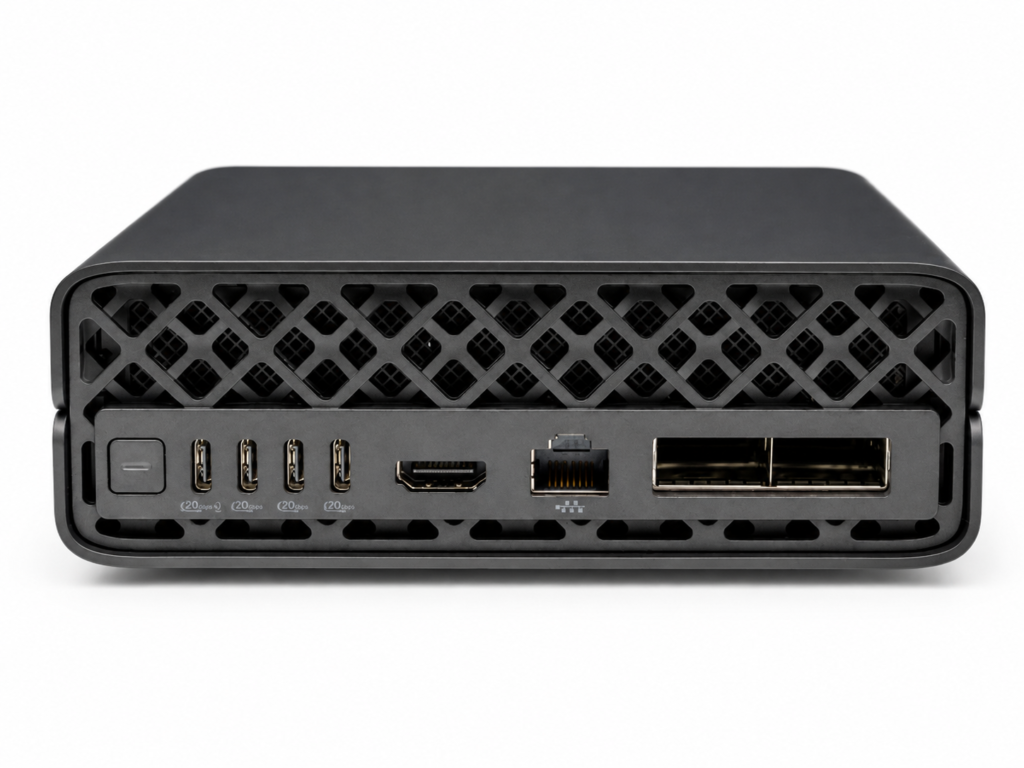
The body is black with softly rounded corners, styled close to HP’s existing Z mini machines — put it next to a Z2 Mini and the family resemblance is immediate. The rear follows the platform’s standard layout: one USB-C power port, three USB-C 20Gbps ports, HDMI 2.1a, an RJ-45 10Gbps port, and the two QSFP 200Gbps cages of the ConnectX-7 block — the ready-made path to two-unit clustering, as on every GB10 device.
Key specifications
| Component | Specification |
|---|---|
| Superchip | NVIDIA GB10 Grace Blackwell (20-core Arm CPU + Blackwell GPU) |
| AI performance | 1000 AI TOPS (FP4) ≈ 1 petaFLOP |
| Memory | 128GB LPDDR5x unified, 273 GB/s bandwidth |
| Storage | M.2 NVMe — 2TB / 4TB configurations by market |
| Networking | RJ-45 10Gbps, 2x QSFP 200Gbps (ConnectX-7) |
| Ports | 1x USB-C power, 3x USB-C 20Gbps, HDMI 2.1a |
| Model capacity | Up to 200B parameters per unit; 405B with two units |
| Size / weight | 150 x 150 x 51 mm / ~1.25 kg |
| Operating system | NVIDIA DGX OS 7 (Ubuntu 24.04) |
The three numbers that matter remain the platform’s familiar trio: 128GB of unified memory so AI models escape the VRAM ceiling of discrete GPUs; the ConnectX-7 200Gbps block as a built-in path to a two-node cluster; and an external-adapter power envelope that plugs into a normal office outlet — no extra infrastructure required.
What HP adds to the GB10 family
When the hardware is identical, the right question is: what does HP contribute beyond the shell? Three things stand out from the product’s positioning.
A 2TB option — the rare middle ground. Most of the GB10 family splits into two extremes: 1TB entry or 4TB flagship configurations. HP sells the ZGX Nano in 2TB and 4TB — putting it, alongside the ASUS GX10, in the small club offering a 2TB middle tier: enough to keep several large models and datasets local without paying for the top configuration.
The enterprise weight of the Z brand. For organizations already running Z workstations, the ZGX Nano enters through familiar doors: the same procurement channel, the same support chain, the same IT team that already knows how to work with HP. International reviews of the machine lean the same way — a desk-side AI node for enterprise environments that value security and sustainability, exactly the traditional Z customer’s taste.
A ZGX family with headroom. The ZGX Nano is the first rung of HP’s new AI lineup — with more powerful ZGX systems above it for bigger problems. For enterprises that want a single vendor across the whole journey from experimentation to deployment, that portfolio story carries real weight against vendors with just one GB10 model.
Against its GB10 siblings
Within the family, the ZGX Nano’s position is clear: it competes most directly with the Acer Veriton GN100 and Dell Pro Max GB10 in the “easy-to-procure enterprise device” group — where brand, distribution, and service contracts outweigh spec sheets. Unlike the GN100 (a single 4TB configuration), HP adds the 2TB choice; unlike lab-leaning units like the GIGABYTE ATOM, the ZGX Nano speaks corporate IT’s language. And for buyers wanting the family’s cheapest entry or the first-party reference, the ASUS GX10 1TB and DGX Spark remain the top picks for those two needs — as analyzed in our GB10 machines overview.
The family-wide caveats apply unchanged: 128GB is a hard, non-upgradable ceiling; a single M.2 slot (choose the right capacity up front); built for inference and light fine-tuning rather than training large models from scratch; and it’s a dedicated Arm + Linux machine, not a general-purpose PC.
Who is the HP ZGX Nano for?
The best matches, from the product’s positioning and Prology’s consulting experience: businesses already in the HP ecosystem — adding an AI device to an existing contract and support chain beats onboarding a new vendor; process- and security-minded organizations — banks, insurers, and corporations with strict hardware standards, where the Z brand already sits on the approved list; AI teams inside large enterprises needing a local development node beside their existing Z workstation fleet; and buyers who want the 2TB tier with an enterprise-class brand behind it.
Not the optimal pick if: you need the lowest entry cost (the GX10 1TB does it better); you’re a pragmatic lab or startup indifferent to brand (the ATOM competes harder at 4TB); or your needs stop at commercial model APIs — in which case no GB10 machine is necessary yet.
Frequently asked questions
Is the ZGX Nano faster than other GB10 machines?
No — same GB10, same 128GB, same 1 petaFLOP. The differences are design, storage options, brand, and support channel.
What OS does it run?
NVIDIA DGX OS 7 on Ubuntu 24.04 with the NVIDIA AI stack preinstalled — a dedicated AI machine, not a Windows PC.
Can it cluster with a GB10 machine from another vendor?
Technically feasible on the shared ConnectX-7 and DGX OS platform, but the officially supported configuration remains two units of the same model — the family-wide rule.
2TB or 4TB?
Data on a NAS or network storage: 2TB is enough. Keeping many models and datasets local, or sharing the machine across a team: go straight to 4TB — there’s one M.2 slot, and a later swap means a full rebuild.
What does the ZGX Nano cost?
Pricing varies by 2TB/4TB configuration and timing. Contact Prology for current pricing and availability.
The enterprise piece of a uniform family
The HP ZGX Nano G1n doesn’t try to beat the GB10 family on specs — no machine in the family can — but on what HP does best: a Z brand corporate IT departments already trust, a pragmatic 2TB option, and a ZGX portfolio with an upgrade path above it. If your organization already runs HP hardware and is looking for its first local AI node, this name belongs at the top of the shortlist. Prology distributes the GB10 AI mini server lines and can help weigh the ZGX Nano against the alternatives for your actual workload, procurement process, and existing infrastructure — get in touch for configuration advice and a demo.