

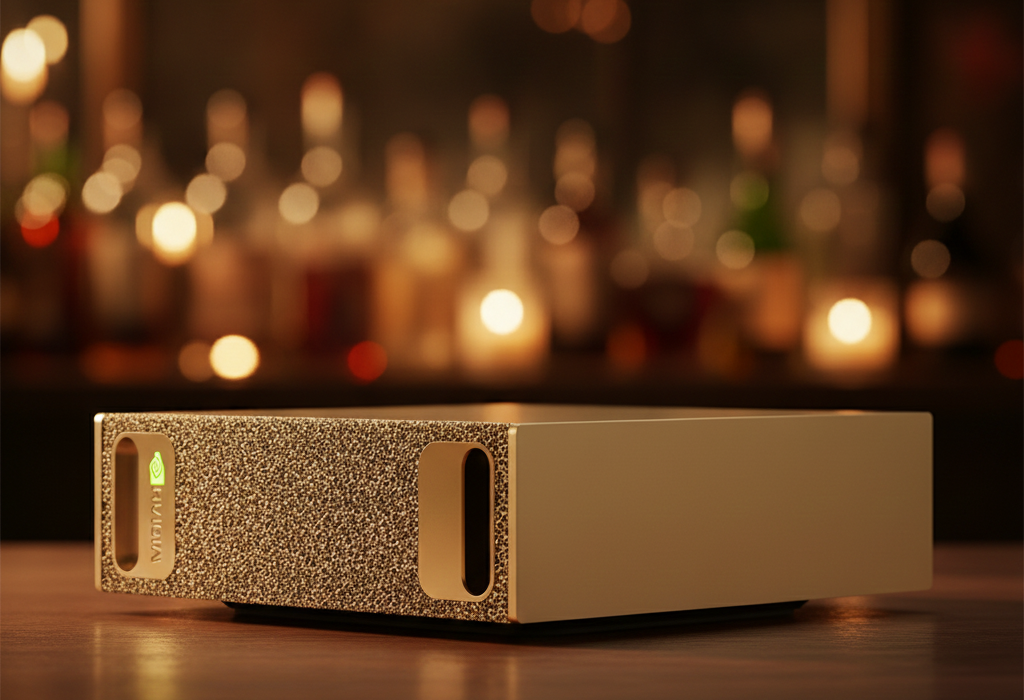
NVIDIA DGX Spark: The Original Desktop AI Supercomputer That Spawned an Entire Category
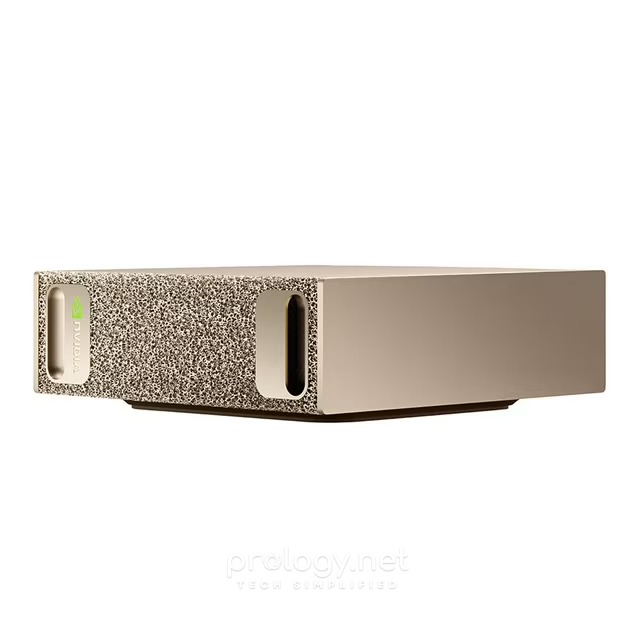
Every “AI mini server” Prology has covered in this series — the ASUS Ascent GX10, the MSI EdgeXpert MS-C931, the GIGABYTE AI TOP ATOM — descends from a single original: the NVIDIA DGX Spark. This is the machine NVIDIA designed and sells itself, wearing an unmistakable champagne-gold shell, and it’s the product that defined the entire “desktop AI supercomputer” category. This article is a full introduction to the original: how it came to be, what’s inside, and when to pick the first-party unit over its OEM siblings.
What is the DGX Spark, and why does it matter?
The DGX Spark first appeared under the name “Project DIGITS,” when NVIDIA unveiled the idea of a personal AI supercomputer that fits in your palm, before being renamed DGX Spark and shipping in late 2025. The DGX name is no accident: it’s the brand NVIDIA reserves for its dedicated data-center AI systems — the machines running in the world’s major AI labs. Putting DGX on a 1.2 kg box was a clear positioning statement: same software platform, same ecosystem, different scale.
At its heart sits the GB10 Grace Blackwell Superchip — a 20-core Arm CPU (10 high-performance Cortex-X925 + 10 Cortex-A725) fused with a Blackwell-architecture GPU on one die, linked by NVLink-C2C, sharing 128GB of unified LPDDR5x memory. NVIDIA then supplied this same chip to OEM partners, spawning the whole GB10 generation the market loosely calls “AI mini servers.” In other words: understand the DGX Spark and you understand the entire category.
Founders Edition design: the one machine that needs no logo
Among a GB10 lineup dressed in black and grey, the DGX Spark is the only one in champagne gold — and the only one you recognize from across the room. Its front and rear faces wear metal-foam panels with a naturally porous structure where no two panels are alike, serving as full-face ventilation grilles and as the machine’s most striking design element. The body measures 150 x 150 x 50.5 mm at 1.2 kg — dimensions nearly identical to the OEM units, since they all share the same board inside.
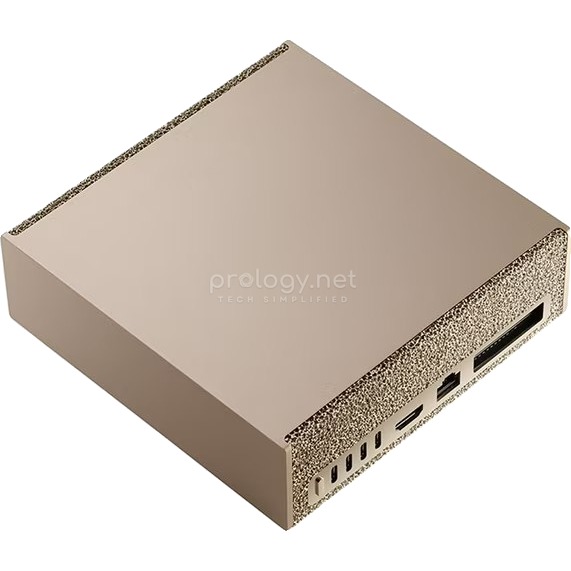
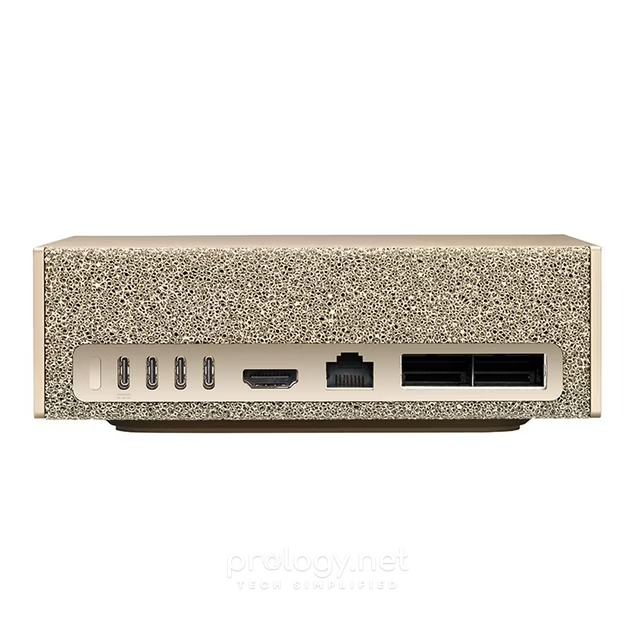
All connectivity sits at the rear: four USB-C ports (one takes power from the 240W adapter), HDMI 2.1a, an RJ-45 10GbE port, and the two QSFP cages of the NVIDIA ConnectX-7 200Gbps block — the familiar layout of the whole GB10 family, which originated with this very reference design.
Key specifications
| Component | Specification |
|---|---|
| Superchip | NVIDIA GB10 Grace Blackwell (20-core Arm CPU + Blackwell GPU, NVLink-C2C) |
| AI Performance | 1000 AI TOPS (FP4) ≈ 1 petaFLOP |
| Memory | 128GB LPDDR5x unified, 256-bit bus, 273 GB/s bandwidth |
| Storage | Self-encrypting NVMe M.2 — 4TB on the Founders Edition; a 1TB version also on the market |
| Networking | 10GbE RJ-45, ConnectX-7 @200Gbps (2 QSFP cages), Wi-Fi 7 |
| Ports | 4× USB-C (1 PD-in power port), HDMI 2.1a |
| Model Capacity | Up to 200B parameters per unit; 405B with two units linked |
| Power | 240W adapter |
| Size / Weight | 150 × 150 × 50.5 mm / 1.2 kg |
| Operating System | NVIDIA DGX OS (Ubuntu Linux based) |
Three things worth pausing on. First, 128GB of unified memory — the number that defines the platform: CPU and GPU address the whole pool, so AI models escape the VRAM ceiling of discrete graphics cards. Second, the self-encrypting NVMe drive comes standard — data protected at the hardware level. Third, the ConnectX-7 200Gbps block — a true data-center network card, there to join two machines into a cluster when the workload outgrows 200 billion parameters.
In the box: the most modest carton in hardware
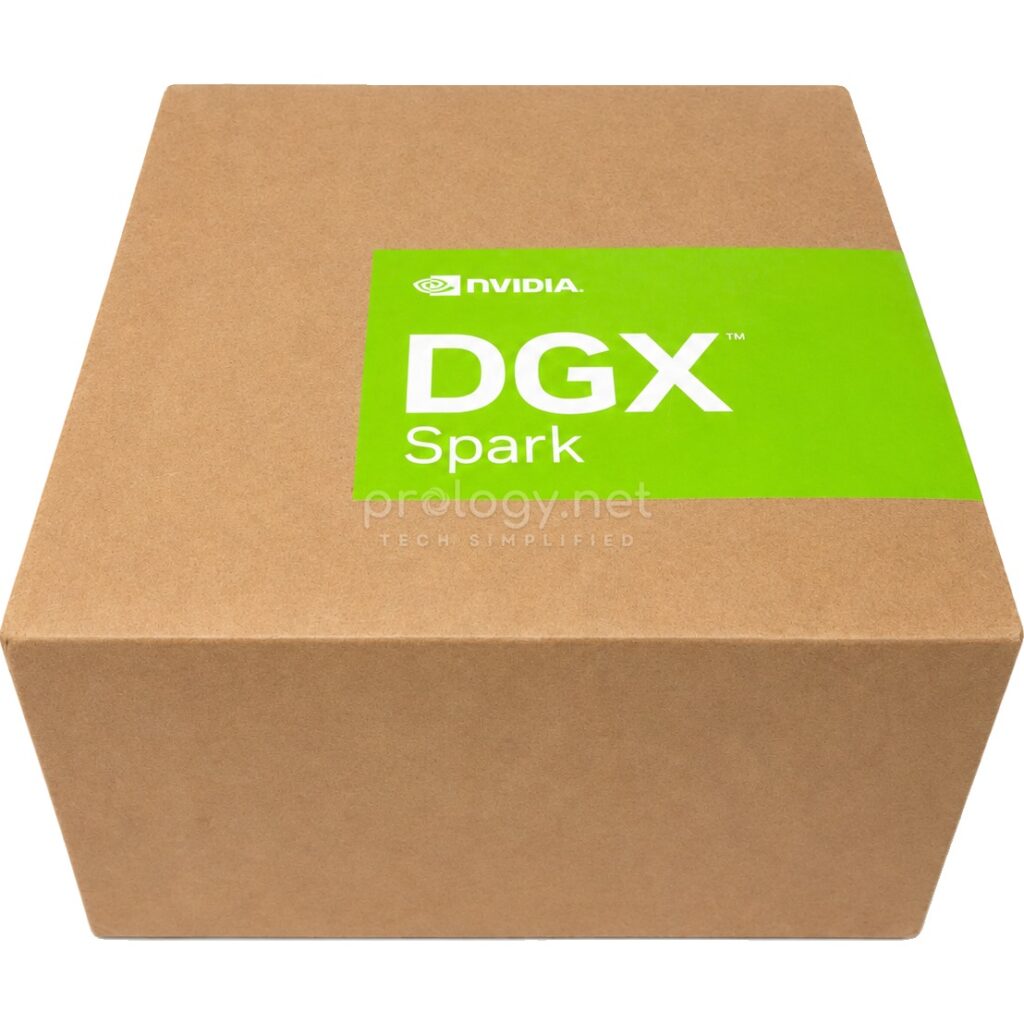
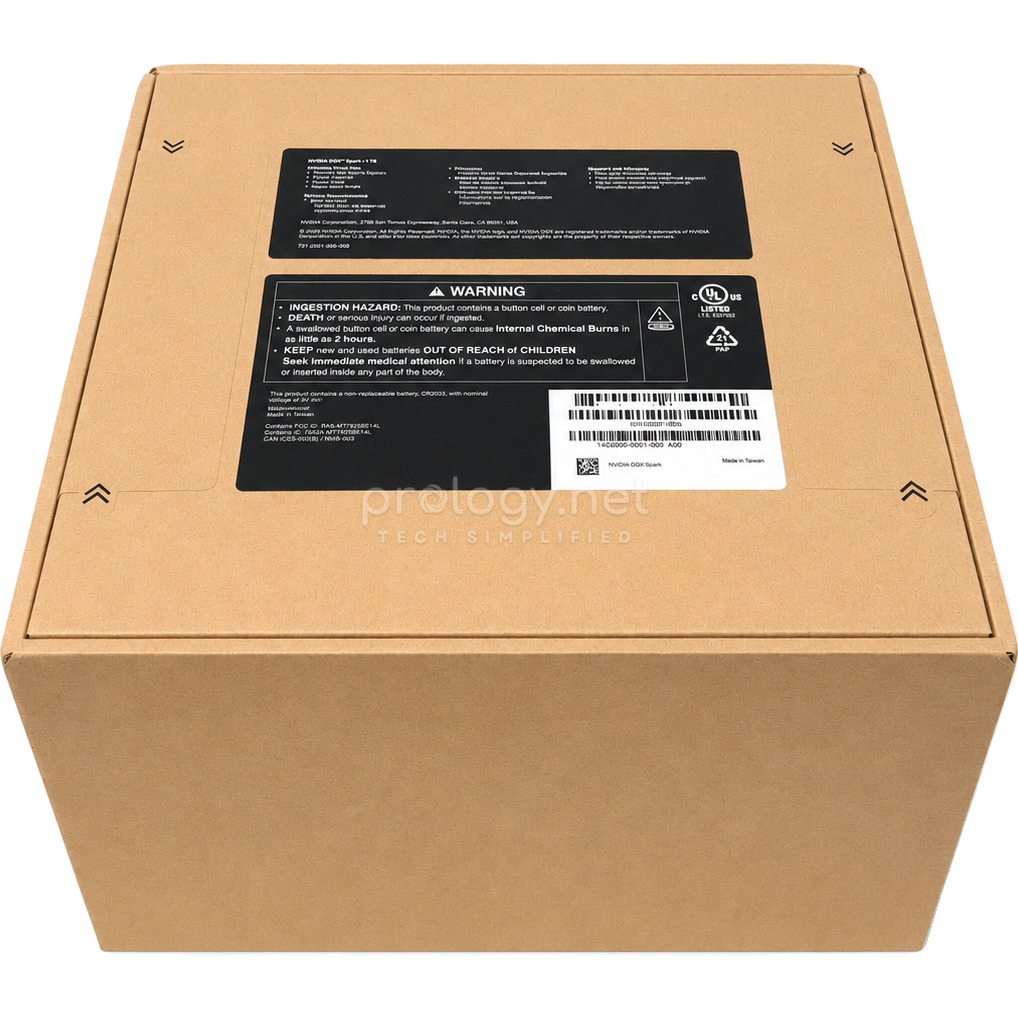
The DGX Spark arrived at Prology’s warehouse in a plain kraft carton with nothing but the signature green “NVIDIA DGX Spark” band — surprisingly minimal packaging for a device in this class. The underside carries a spec label stating the storage version (the unit pictured is the 1TB), the FCC ID, and origin. That’s a detail buyers should note: the storage version is printed right on the box label — check it against your order before breaking the seal.
The software platform: the real value beyond the spec sheet
What separates the DGX Spark from a merely powerful mini PC is the complete NVIDIA software ecosystem preinstalled: DGX OS on Ubuntu with drivers, CUDA, the AI frameworks, and NVIDIA’s AI stack ready to go — power on and start pulling models, instead of spending days building an environment. More importantly, it’s the same stack running on DGX systems in data centers and DGX Cloud: workflows, containers, and code written on a Spark move to larger infrastructure nearly untouched. For teams committed to the NVIDIA ecosystem — which in practice is most of the AI industry — that’s the strongest reason to choose this platform over other unified-memory alternatives.
And like every GB10 machine, two DGX Sparks join into a two-node cluster over the ConnectX-7 ports with a QSFP56 200G DAC cable — extending inference to 405-billion-parameter models. Prology has a dedicated article on that cable and the clustering procedure.
DGX Spark vs. the OEM versions: what does first-party buy you?
The most practical buyer question. On core hardware, the DGX Spark and the OEM units match spec for spec — same GB10, same 128GB, same ConnectX-7. The differences come down to two things.
Design and “original” value. The champagne-gold shell with metal-foam panels is exclusive to the first-party unit — an emotional factor, but a real one, much like Founders Edition graphics cards: instantly recognizable, sought after on the secondary market, and “reference standard” for content creators, demos, and comparison benchmarks.
Configuration and purchase channel. NVIDIA keeps the configuration minimal; the OEMs offer more storage variety — ASUS has the market’s only 2TB tier, MSI pairs self-encrypting drives at both 1TB/4TB with industrial build quality, GIGABYTE focuses on the 4TB segment. Prology has detailed articles on the ASUS GX10 and MSI MS-C931, plus an overview of three GB10 machines for comparison.
The short rule: choose the DGX Spark if you want the first-party reference unit with the iconic design; choose an OEM if you need a wider range of configurations to match your team’s storage needs.
Who is the DGX Spark for?
The Spark buyer profile matches the GB10 platform as a whole: enterprise AI teams that need local fine-tuning and inference with data that never leaves the company; labs and universities that want “NVIDIA-standard” AI hardware for research and teaching; independent developers building on the CUDA ecosystem. The first-party unit’s particular advantage: for organizations buying hardware as a reference benchmark or developing products tightly against the NVIDIA platform, first-party removes every OEM variable.
Conversely, if your needs stop at calling commercial model APIs, or extend to large-scale training from scratch — the answer is the same as for every GB10 machine: this isn’t your device yet.
Frequently asked questions
Is the DGX Spark faster than the OEM versions?
No — same GB10, same 128GB of memory, same 1 petaFLOP. The differences are design, storage configuration, and brand.
How many storage versions does it come in?
The reference Founders Edition uses a 4TB self-encrypting drive; 1TB versions are also on the market (like the unit pictured in this article — the box label reads “1 TB”). Check the version on the box label when your unit arrives.
What OS does it run?
NVIDIA DGX OS — a customized Ubuntu Linux build with the NVIDIA AI stack preinstalled. It’s a dedicated AI machine, not a general-purpose Windows PC.
Can a DGX Spark cluster with an OEM unit (GX10, MS-C931…)?
They share the ConnectX-7 platform and DGX OS, so it’s technically feasible — but the officially supported, safest configuration remains two units of the same model.
The original of an entire category
The DGX Spark isn’t the most configurable machine in the GB10 family — but it’s the device that defined the whole category, carries the software ecosystem that gives the platform its value, and wears the most memorable design in AI hardware today. Choosing between Spark and OEM ultimately comes down to brand, configuration, and your actual needs — and the best way to decide is to see them side by side. Prology stocks the DGX Spark along with the other GB10 machines and clustering accessories — get in touch for configuration advice on your actual workload.